



Premium cigars
The Chen Zhi Case: AI Hallucinations in a Federal Courtroom
Par La rédaction,
le 5 June 2026
In the American part of the case, the prestigious law firm Sullivan & Cromwell had to admit that it had been the victim of “hallucinations” by artificial intelligence.
On April 9, 2026, Sullivan & Cromwell LLP—one of Wall Street’s most prestigious law firms, whose fees easily exceed $2,000 an hour—filed an emergency motion in Manhattan bankruptcy court on behalf of Interpath Advisory, the liquidator of Chen Zhi’s assets located in the British Virgin Islands (BVI). The document was riddled with legal precedents. The problem: several of them were bogus.
But why did this case end up in an American court? In January 2026, the Attorney General of the British Virgin Islands (BVI) obtained a ruling from the Eastern Caribbean Supreme Court (ECSC) appointing Interpath Advisory as the provisional liquidator of 30 offshore companies linked to Chen Zhi—including Simply Advanced Limited, the holding company that controls 57% of Allied Cigar Corporation, co-owner of Habanos S.A. Interpath is now seeking recognition of this BVI procedure in US courts in order to access assets and financial documents held in the United States and extend its mandate to other jurisdictions. It is this request for recognition—filed on April 8, 2026, in the Manhattan Bankruptcy Court—that led to the emergency motion drafted—somewhat hastily—with the help of an AI tool.
“Trust nothing and verify everything”
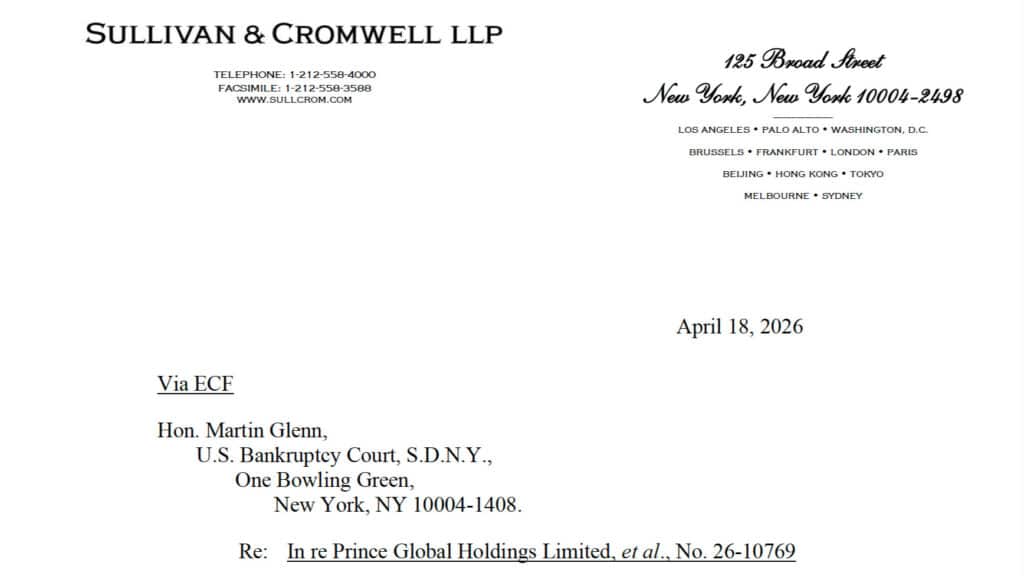
These are “hallucinations”—the established term for the fabrications of generative artificial intelligence tools, which boldly invent legal references, case numbers, and judgment conclusions that never occurred. The firm itself acknowledges this in a letter of confession addressed to Judge Martin Glenn on April 18, signed by partner Andrew Dietderich: “The inaccuracies and errors in the motion include artificial intelligence ‘hallucinations.’”
Sullivan & Cromwell specifies that it has “comprehensive and rigorous” internal policies on the use of AI, including mandatory training for any lawyer wishing to access it, and a principle of systematic verification: “trust nothing and verify everything.” The firm acknowledges, offering profuse apologies to the judge and the opposing party, that these policies were not followed in this particular case.
The motion was corrected and refiled the same day. Honorable Judge Martin Glenn of the U.S. Bankruptcy Court for the Southern District of New York nevertheless granted the requested provisional protection on April 23, and the case proceeded.
The interesting detail: it was Boies Schiller Flexner LLP—the opposing firm, representing Cosimo Borrelli, the rival administrator appointed by Chen Zhi’s partners—that alerted Sullivan & Cromwell to its own errors. Andrew Dietderich made a point of calling them personally to thank them.
Laurent Mimouni
You might also like



Latest articles

27 October 2026
The Quai d’Orsay Concordia LE 2026 Unveiled In Madrid

27 October 2026
Belgium Postpones Smoking Lounges Ban Beyond January 2027

26 October 2026
New York And Las Vegas Now Have Their Own Davidoff

26 October 2026
Fifth Avenue Seeks “Alternative” Supply Arrangements for German La Casa del Habano Stores

24 October 2026
Registration For The First Honduras Festival Is Now Open
Publicité
All the latest cigar news
Discover